
Legitimate Intermediaries and Nested Funding Pools
Exploring the Real-World Practice of Bioregional Funding Ecosystems

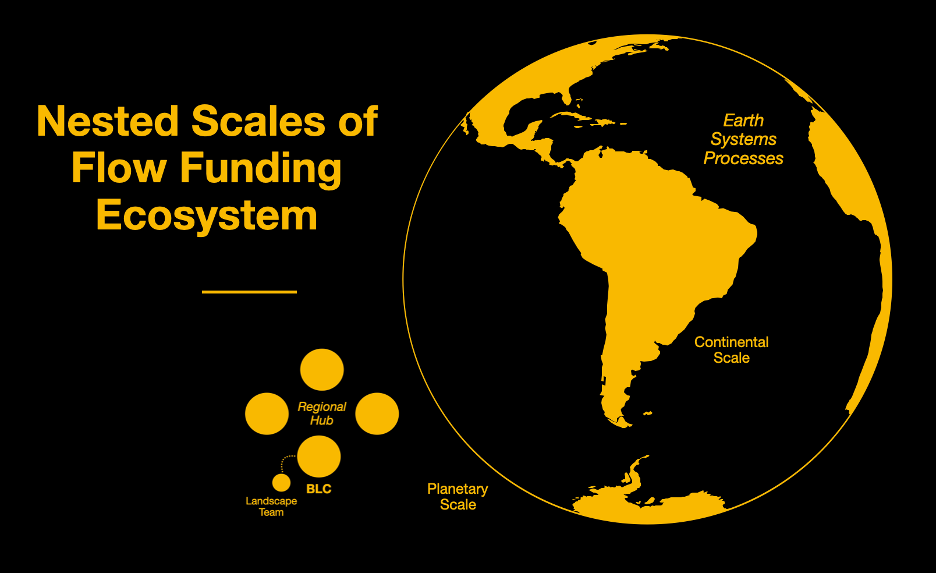
Today I want to share more about how we are structuring the bioregional funding ecosystems that we create with local teams in different parts of the world. There are a lot of theoretical discussions about financial systems for Earth Regeneration, but not very many explorations based in the daily practice of creating one. I hope today’s article is helpful in this regard -- by offering insights based in our direct experiences of mobilizing financial resources into a very complex real-world environment.
The topic I want to explore today is that of Legitimate Intermediaries in a Nested Funding Pool. What are they? Why are they so important? How do we create them? How can we evaluate if they are working? We will use an example where there is still learning to be done. I will apply this conceptual lens to the practice of creating the first Northern Andes Regeneration Fund to show how important it is in practical terms.
Yet I will take care to keep the information that I share at a general level because of the delicate nature of an inquiry like this. There are real communities involved. People and places that I deeply care about. Human leadership that is still a work in progress. Challenges that have yet to be addressed. More details can be shared privately if interested donors/investor wish to reach out and discuss how they can support this work in the context of the Northern Andes. With these caveats in mind, let us begin.
What IS an Intermediary and How Might They Be Illegitimate?
We are dealing with nested systems in the work of bioregional regeneration. There are local actors who hold and implement regenerative processes within each community. There is a territorial scale of landscapes across and within which these local processes play out. Coordination is needed within and between territories to move up to the bioregional scale. Support infrastructure is needed to monitor, evaluate, administer, and coordinate among all levels involved.
In the case of the Northern Andes, this takes the form of a network of territories. All of them are in the country of Colombia. Each territory has a community foundation that maps local processes and coordinates the collective agenda of its multi-stakeholder network within its territory. A support organization has been set up to help the community foundations. I was involved as a founding member of the movement of territorial foundations in Colombia. I was also a co-founder for one of the territorial foundations. I was the primary mobilizer of funding for local efforts across the span of several years. It was my idea to create the Northern Andes Regeneration Fund in the first place. I then went on to connect a large foundation with this local effort and mobilized more than one million dollars into the local ecosystem.
All of this is to say that I have intimate knowledge about the bioregional funding ecosystem we will discuss today. And that I played several key roles in its development over the span of many years. With all of this in mind, I want to share a disturbing statistic. If we look at all the money from international development that flows into Colombia, only 1% makes it to local people in any given community. This means 99% of the money arrives to intermediaries who are not part of the local communities that the money is presumed to serve.
This information gives us context for defining what an intermediary is. An intermediary is any relationship between actors or stakeholders of a system where they have power to represent and act upon this relationship.
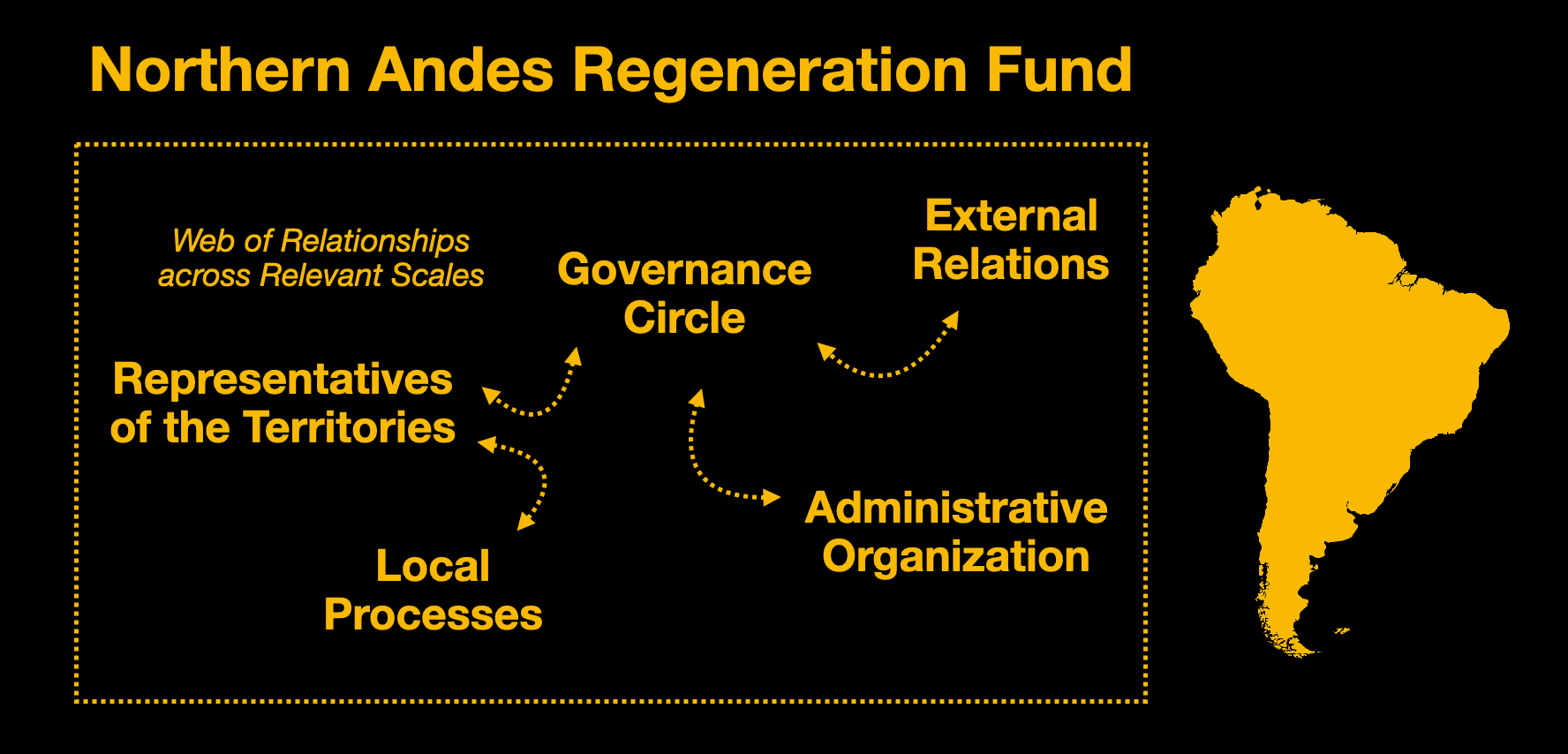
In the Northern Andes Regeneration Fund, we initially identified the following intermediary relationships:
Local regenerative practitioners represent their own projects on the ground.
A territorial actor (the community foundation) represents local regenerative processes through portfolio approaches, mapping of local efforts, the construction of a territorial narrative, and the distribution of funding into the local community.
A governance circle comprised of community foundations represents the network of territories in relation to the funding ecosystem.
An administrative organization represents the legal management of the fund itself.
An ambassador to external actors represents this ecosystem of relationships to potential investors and strategic partners.
All of this is depicted in the graphic below. I held all these roles except that of the administering organization. This is to say that I engaged in local regenerative practices, was part of the founding team for one of the community foundations, was in the governance circle of the fund, and was an ambassador to cultivate external support for the funding ecosystem.
(Let me also note that I withdrew from membership in both the local community foundation and the governance of the fund after playing a whistleblower role of naming governance concerns that were not being addressed in an ethical manner.)
Now the question becomes How to Tell if an Intermediary is Legitimate? What happens if a representative in one of the territories does not give an honest or complete account of what is happening with local processes? How could the narrative of the Northern Andes Regeneration Fund elevate the administrative organization to the detriment of local actors in the territories themselves? When is an intermediary behaving in a manner that undermines the legitimacy of the funding ecosystem in its entirety?
This funding ecosystem was created in 2024. I brought in $150,000 US of seed funding and a structuring process began that included educating the territorial foundations about bioregional-scale regeneration. Local regenerative processes began to get mapped within the four thematic areas of regenerative education, regenerative economy, ecosystem restoration, and territorial healing. Throughout 2025, I brought an additional $600,000 US into the fund (as well as more than $300,000 US into our local territory) and began to receive invitations to visit several of the territories involved to help them deepen their understandings of regeneration and bioregionalism among local stakeholders.
It was through this process that I developed the concept of the legitimate intermediary. Why did I do this? Because I began to see patterns that would hinder the collective vision to regenerate the entire Northern Andes bioregion. For example, I began to learn how local efforts that were quite powerful and effective were not being communicated to the governance circle of the fund. This was partly due to lack of capacity in a local community foundation, and because there was a history of distrust among some community foundations with respect to the support organization that administers the fund.
I also began to see how some of the community foundations would intentionally exclude key regenerative processes in their local territories for political reasons. Greenwashing. Suppressing key actors to advance personal agendas, Things that are quite normal, yet need to be addressed if the funding ecosystem is to achieve its ambitious goals. I also learned about specific conflicts between members of a community foundation where the support organization behaved in a biased manner. And I was also made aware of situations where some territories were given priority over others without transparency or accountability.
Now we can begin to name what an illegitimate intermediary looks like in this situation. A community foundation can misrepresent what is happening on the ground. Local actors can misrepresent their contributions to a territorial narrative. The administrative support organization can hinder accountability and behave in a biased manner. And so forth.
How Might This Be Addressed at the Structural Level?
We cannot address issues that we don’t know about. The first step was to communicate what was being observed and provide an analytic lens that makes sense of it. This was how the concept of a legitimate intermediary came into being. By observing that several key relationships exist where an intermediary role needs to be cared for if the system is to work at all necessary scales. The first structural element is the map of relationships where an intermediary exists and criteria are identified for how it can become legitimate in the funding ecosystem.
Having such a structural map in place enables evaluations to occur. Where are the intermediary relationships in the system? How are they behaving right now? What kinds of improvements might be recommended based on what is learned? I attempted to bring this analysis into the group and discovered that a specific manipulation of the field was taking place. A power dynamic of exclusion and control of information was hindering the effort to improve governance. A power dynamic was in play and the response was to withdraw even more deeply into its own self-preservation.
This is why I came to the conclusion that I needed to name what I was observing and then leave the governance of the fund -- even though I was the principal actor in both its creation and the mobilization of 100% of the funding that came in. What I observed was a web of relationships that need deeper healing. And that the concept of a legitimate intermediary could bring structural (and impersonal) clarity to how the funding ecosystem’s governance could be improved. My recommendation was to learn about bioregional mapping and engage in deeper proactive communications about the regenerative work on the ground.
Focus on “verifiable truths” through the mapping and storytelling. Prioritize that the majority of available funding goes to local processes. Support how the stories get told in an honest and accurate manner. Create information feedbacks that reveal blind spots and biases. Cultivate an ethical space of responsibility for those who are represented in the stories that are told -- and do so at all relevant scales of the nested system.
You can see how political this becomes. It is not easy to do. Yet it is vital if the bioregional funding ecosystem is to emerge into all of the nested scales involved. I learned that a concept like what is a legitimate intermediary brings forth the need to map the relational field. Identify key criteria for healthy function. Discover weaknesses and name them as opportunities for improvement. Make systemic recommendations based on these kinds of learnings.
I also learned that in this specific case, there was something like a cultural immune response that meant I should withdraw my presence. I wish all involve in the Northern Anes Regeneration Fund the success that they seek. My roles in this system came to their own limits and I moved on to focus my energies on the creation of bioregional learning centers.
Our work to create nested funding pools continues. We have a planetary vision and still engage in local work that focuses on the Northern Andes. What I hope this article can do is provide insights about how complex the real-world practice of bioregional finance truly is. We are learning by doing and what we learn is deeply practical. I hope this is helpful for all who seek to provide financial support to local regenerative efforts. We deeply need financial flows that are legitimate and healthy into the planetary network of bioregions that has been emerging throughout the last several years.
In closing today, I will add that part of the clarity that emerged for me personally was that this learning process revealed who I could legitimately work with and how to continue holding the level of integrity that I demand of myself in the Northern Andes context. I was able to see which actors care about being legitimate intermediaries and which actions made visible those who do not. This too was vital discernment on the path that I walk to help local bioregional teams do their part to regenerate the Earth.
Onward, fellow humans.
Thanks so much, Joe. Great that you name these issues. Very difficult to identify “verifiable truths” through the mapping and storytelling…and as you say brings up loads of political, outsider and cultural issues.
Dear Joe, I thank you for your transparency and sensitivity in sharing your thoughts, born of these immersions into "nested funding".
My sense, and really our sense in this local BLC community, is that we begin at the relational level, that the vital need right now is to develop deep communion with one another: to really listen to and come to know one another, listening together at the same time with our landscapes and watersheds and the plants, animals, stones, and all that dwell with us here.
We were not socialized as children to be cooperative and deeply communing. Out of this emerges deep trust of one another, and the opportunity for the miracle of what is needed to come. Perhaps that will be in the form of monetary funding, but there are many other forms of contribution and participation that are as much if not more valuable.
This may sound like a slow naïve approach, especially as collapse is surely already in our midst, and so it is a profound act of faith. But it seems to me this is the only way we can return to the non-monetized, gift economy way of life we have known for thousands of generations in harmony with life in this cosmos. I welcome your thoughts...